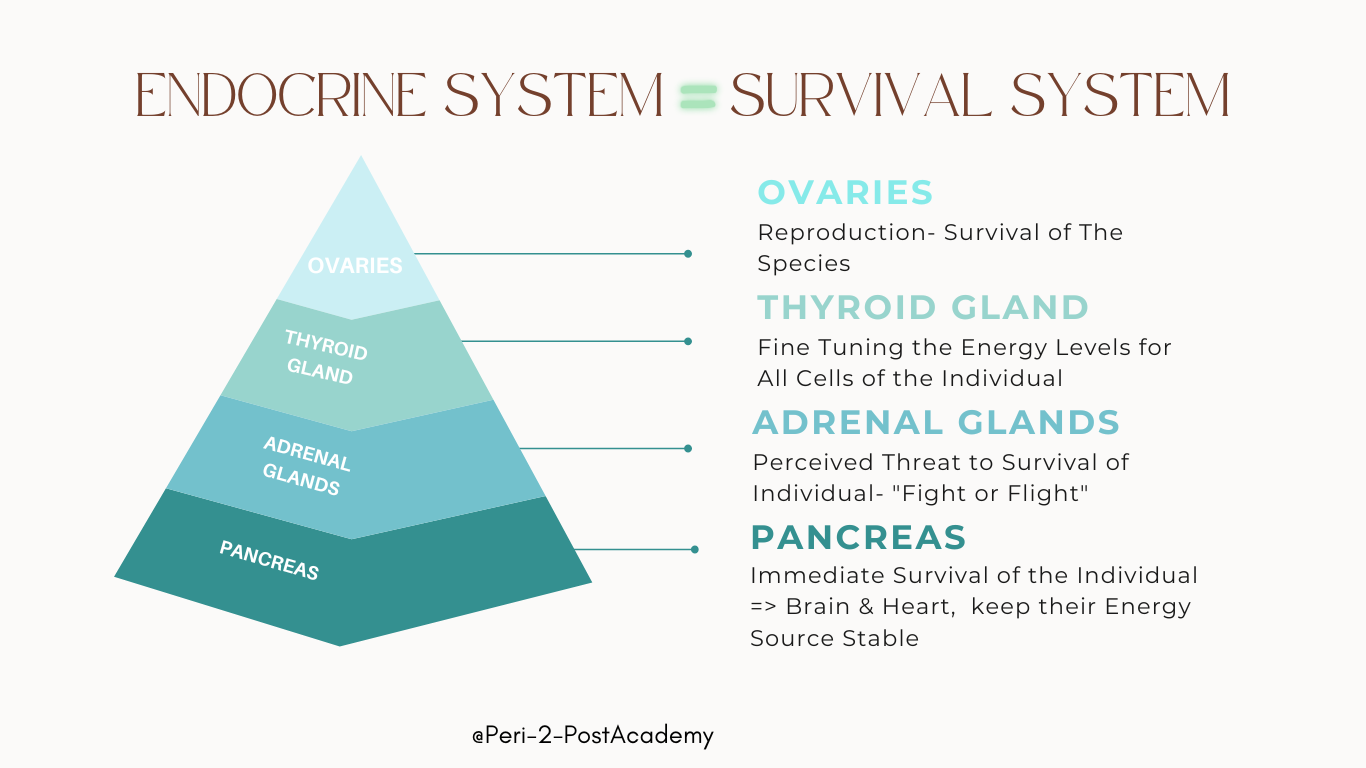
The Endocrine System Is a Survival System
Hot flashes.
Sleep that suddenly becomes lighter or more fragmented.
Anxiety that seems to appear out of nowhere.
Weight gain that doesn’t respond the way it once did.
Many women begin noticing these kinds of changes during the perimenopause to menopause transition.
And while these symptoms are often discussed individually; as sleep problems, stress, metabolism issues, or hormonal imbalance, they are actually connected by something much larger.
They are signals of a shift occurring within the endocrine system.
To understand why these symptoms appear, it helps to understand something fundamental about how the endocrine system works.
The endocrine system is not simply a reproductive system.
It is also a survival system.
The Endocrine System: A Network Designed for Survival
The endocrine system is made up of several glands throughout the body, including the hypothalamus, pituitary, thyroid, adrenal glands, pancreas, and reproductive organs.
Each gland produces hormones that travel through the bloodstream and act as signals to different tissues.
While these glands carry out different roles, they share one primary function as a system:
Supporting survival.
Biologically, survival can be thought of in two ways.
First, the survival of the individual.
Second, the survival of the species, which involves reproduction.
But when resources are limited or the body perceives stress, the endocrine system always prioritizes the survival of the individual first.
This means that reproduction is not the body’s top priority.
In biological terms, reproduction is actually a luxury function.
If the body senses that energy or resources are needed elsewhere, it may redirect those resources toward systems that help maintain immediate survival.
Protecting the Brain and Heart Comes First
Your body’s first priority is maintaining a steady supply of energy to the brain and the heart.
In fact, other organs will sacrifice optimal function if necessary to ensure these vital organs continue receiving energy.
One of the primary ways the body maintains this energy supply is through blood sugar regulation.
Stable blood sugar provides the fuel that keeps the brain functioning and the heart beating.
When blood sugar rises too high or drops too low, the body activates several endocrine glands to restore balance.
Two of the most important are:
The pancreas, which releases insulin to lower blood sugar when it rises.
The adrenal glands, which release hormones such as cortisol to increase blood sugar when it falls.
When blood sugar swings frequently; whether from skipping meals, irregular eating patterns, or diets heavily dominated by refined carbohydrates, the pancreas and adrenal glands must work harder to stabilize energy.
Over time, this increased demand can place strain on these foundational glands of the endocrine system.
And when those glands are under stress, the effects can ripple throughout the entire hormonal network.
Stress Signals and Hormonal Shifts
Another powerful influence on the endocrine system is stress.
The brain, particularly the hypothalamus and pituitary, constantly scans the environment for signals that indicate threat or stress.
Historically, stress was often short-lived and physical.
Running from danger or hunting for food would activate the stress response temporarily, after which the body would return to balance.
Modern stress looks very different.
Deadlines.
Financial pressures.
Relationship conflicts.
Sleep deprivation.
Technology frustrations.
There are also physical stressors such as inflammation, injury, illness, food sensitivities, and environmental toxins.
From the perspective of the endocrine system, all of these signals can activate the stress response.
When the body perceives ongoing stress, it redirects resources toward systems that support immediate survival.
This can mean that the building blocks and energy normally used to produce sex hormones are instead directed toward glands that help manage stress and energy regulation.
The Thyroid and Energy Production
The thyroid gland is another important part of this hormonal network.
Thyroid hormones regulate metabolic energy throughout the body. They help determine how efficiently cells produce and use energy.
Every cell in the body relies on this energy to carry out its functions.
The ovaries may know how to produce estrogen and progesterone, but hormone production requires both nutrients and cellular energy.
If the body is diverting resources toward managing stress or stabilizing blood sugar, fewer resources may be available for reproductive hormone production.
This is one way imbalance can cascade throughout the endocrine system.
Why Midlife Symptoms Can Feel So Widespread
When we view the endocrine system as an interconnected network rather than separate organs, something important becomes clear.
Hormonal symptoms during the peri-to-post transition are rarely isolated.
Hormones influence multiple systems simultaneously, including:
The brain
Metabolism
Sleep regulation
Temperature control
Tissue health
This is why symptoms during midlife can feel so varied.
Sleep changes.
Mood shifts.
Energy fluctuations.
Hot flashes.
Changes in metabolism.
Bladder or vaginal tissue changes.
These symptoms are not random.
They reflect changes in hormonal signaling across multiple systems.
Supporting the System, Not Just One Hormone
The encouraging news is that the endocrine system is highly responsive to the signals it receives.
Because hormones respond to cues about stress, energy availability, sleep, and overall physiological balance, small shifts in daily habits can have meaningful effects.
Supporting stable blood sugar.
Reducing chronic stress signals.
Protecting sleep.
Providing adequate nutrition.
All of these actions help send signals to the endocrine system that resources are available and balance can be restored.
When we understand that the endocrine system is fundamentally a survival system, our approach to hormone health becomes much clearer.
Instead of trying to fix a single hormone in isolation, we begin supporting the systems that influence hormonal balance as a whole.
And that is often where real change begins.
A Different Way to Think About Midlife
Many women have been told that midlife symptoms are simply something they must endure.
Others are told the answer is to push harder — eat less, exercise more, try to regain control.
But when we understand how the endocrine system works, a different picture emerges.
Midlife is not a failure of discipline.
It is a biological recalibration.
And when the rules change, the strategy must change as well.