When you truly understand estrogen, you realize it was never “just” about reproduction.
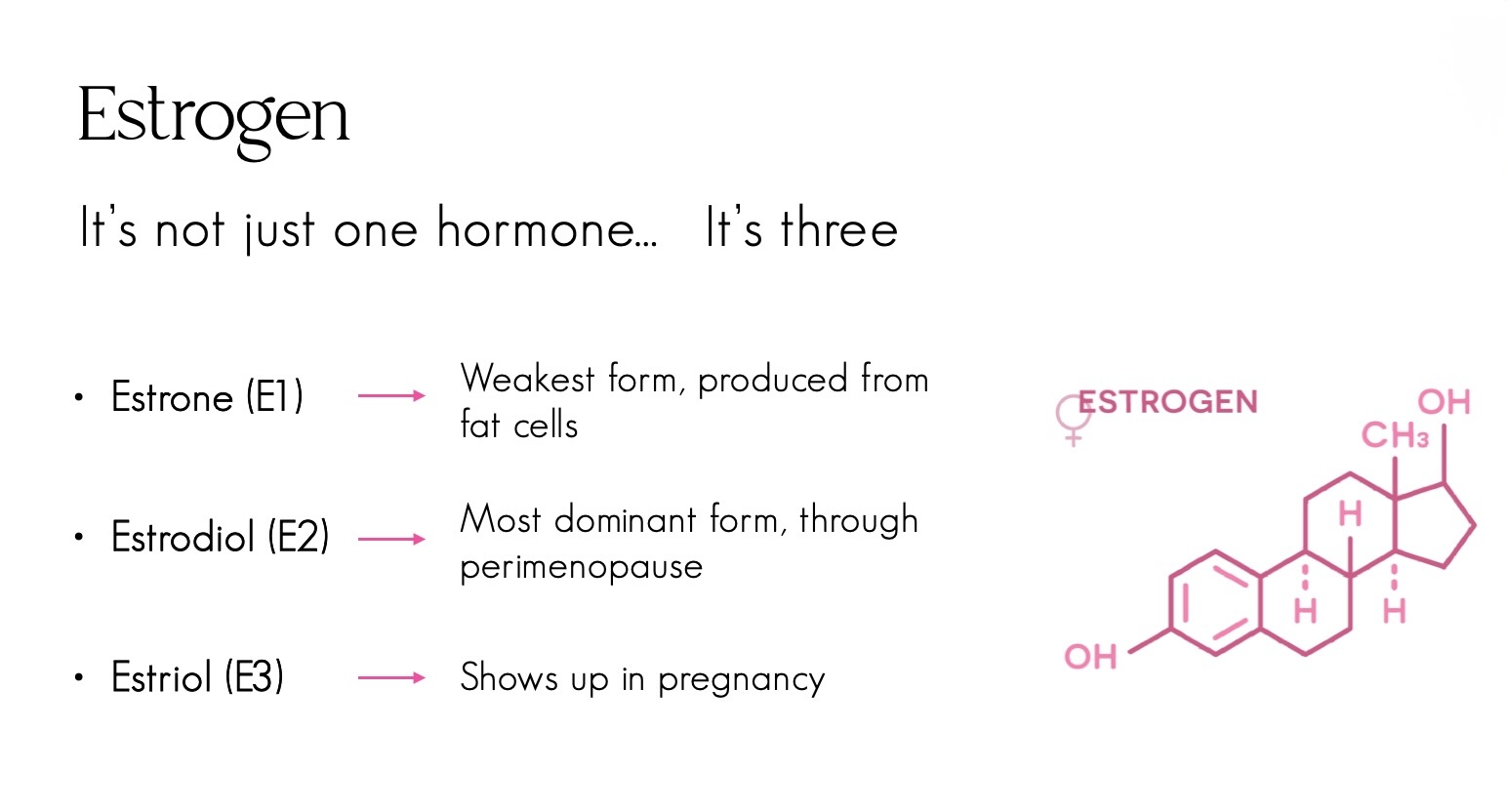
In fact, estrogen isn’t even one hormone.
It’s three:
• Estrone (E1)
• Estradiol (E2)
• Estriol (E3)
They’re produced primarily in the ovaries, but also in fat tissue and, to a lesser degree, in bones, the brain, the adrenal glands and the skin.
And while we often associate estrogen with fertility and the menstrual cycle, estrogen receptors exist throughout the entire body; in the brain, bones, heart, immune system, skin, and urinary tract.
This is why changes in estrogen affect far more than periods.
What Estrogen Actually Supports
Estrogen influences:
• Blood sugar regulation
• Cholesterol balance
• Neurotransmitter production
• Melatonin production and sleep
• Stress response
• Bone density
• Skin elasticity and hair health
• Vaginal and urinary tract tissue
• Cognitive function
• Cardiovascular health
• Even aspects of empathy and emotional processing
When women say,
“I don’t feel like myself anymore,”
Often what they’re describing is the ripple effect of declining estradiol.
Not weakness.
Not aging poorly.
Physiology shifting.
How Estradiol Is Made (And Why That Matters)
Estradiol (E2) is the primary estrogen involved in fertility, and is the strongest of the three estrogens..
Its production in the ovaries begins with FSH, follicle stimulating hormone, which stimulates ovarian follicles.
Those follicular cells produce estradiol.
But here’s something many women don’t realize:
All sex hormones begin with cholesterol.
Cholesterol is the foundational building block.
It’s converted into androgens (the testosterone family of hormones), and testosterone is then converted into estradiol within the ovaries.
You make estrogen from testosterone.
This is not random.
It is a structured biochemical pathway.
Understanding this matters, because when estrogen declines, it affects systems that have relied on it for decades.
The Shift During Menopause
Throughout your reproductive years, estrogen naturally fluctuates during the menstrual cycle.
You might notice:
• Breast tenderness
• Mood shifts
• Energy changes
These are normal cyclical patterns.
But during the peri-to-post transition, estrogen doesn’t just fluctuate.
It becomes unpredictable.
And eventually declines more dramatically.
That’s when symptoms can feel overwhelming.
Because estrogen wasn’t just supporting fertility.
It was stabilizing multiple systems at once.
Awareness Becomes Powerful
When the ovaries are no longer the body’s primary source of estrogen, production doesn’t stop, it simply shifts.
Estrogen continues to be made in other tissues like the adrenals, brain, bones, liver, circulatory system, and even the skin. Much of this happens through the conversion of adrenal hormones (like DHEA and testosterone) into estrogen.
This is where your awareness becomes powerful.
Because when you understand how your body adapts, you can begin supporting the systems that now carry more responsibility.
Supporting your adrenals through stress regulation and balanced blood sugar.
Nourishing healthy cholesterol levels so your body has the building blocks it needs.
Caring for your liver so hormone conversion stays efficient.
These aren’t extreme overhauls. They’re steady, responsive shifts, the kind that honor your body’s intelligence.
And over time, those shifts can profoundly influence how you feel.